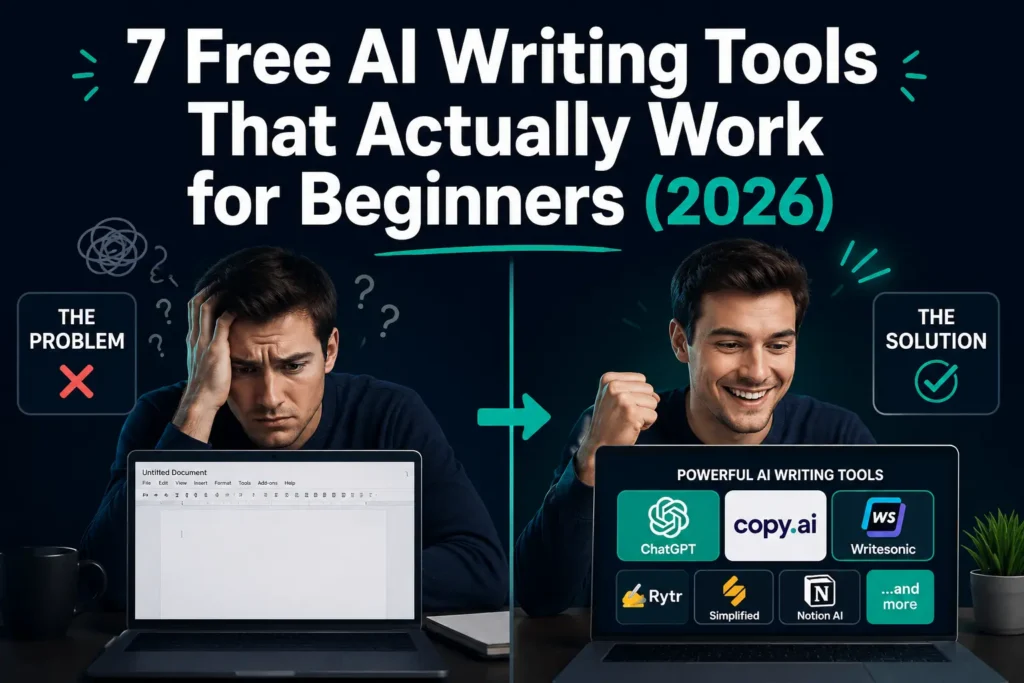
I’ll be honest with you. A year ago, I was skeptical about using AI writing tools for anything beyond a quick draft. Then one month I decided to actually commit to testing the best AI for writing and track every dollar it helped me make. The result: $500 in affiliate commissions, AdSense revenue, and paid content gigs, all driven by content I produced faster and smarter using these tools.
This is not a “just use ChatGPT” article. This is a breakdown of the exact AI writing tool stack I used, what each one did for me, and whether it is actually worth your money in 2026.
Using this tool? Got questions?
Ask me anything on Telegram - free honest answers before you spend your money.
Quick Disclaimer: I independently tested every tool on this list. Some links are affiliate links, which means I earn a small commission if you sign up. That does not change my opinion. I only recommend tools I have actually used and found useful.
Best AI Writing Tools at a Glance
- Writesonic – Best for SEO content and blog writing
- Jasper – Best for teams and brand consistency
- Copy.ai – Best free AI chat for writing
- Rytr – Best budget AI writing tool
- ChatGPT – Best all-purpose AI chatbot for writing
How AI Writing Tools Actually Made Me $500
Before I get into the tool reviews, let me explain how this worked, because knowing the “how” will help you replicate it.
I run a review blog (this one). Every article I publish targets a specific keyword. More articles means more traffic. More traffic means more AdSense clicks and more affiliate link clicks. Simple math.
The bottleneck was always time. Writing one good SEO article used to take me 4 to 5 hours. With the right AI for writing, I cut that down to 90 minutes per article. That let me publish 3 times more content in the same month. More content meant more rankings. More rankings meant more money.
The $500 was not magic. It was volume multiplied by quality, and AI writing tools gave me both.
What Makes a Good AI Writing Tool in 2026?
A lot has changed. Two years ago, any tool that could string together coherent sentences felt impressive. Now, GPT-4 and Claude are baked into Google Docs, Microsoft Word, and Notion. The bar has moved.
Here is what I actually looked for when testing these tools:
- SEO awareness: Does the tool understand keywords and help you rank, or does it just write generic text?
- Output quality: Does the writing sound human enough to publish with light editing?
- Speed: How fast can you go from idea to publishable draft?
- Control: Can you set a brand voice, adjust tone, and guide the output?
- Pricing: Is the price justified by the output? Most tools use the same underlying LLMs, so expensive does not always mean better.
The Best AI Writing Tools in 2026 (Tested and Ranked)
| Tool | Best For | Standout Feature | Starting Price |
|---|---|---|---|
| Writesonic | SEO and content marketing | Built-in keyword and SEO tools | $49/month |
| Jasper | Business teams | Brand voice and knowledge base | $69/month |
| Copy.ai | Free AI chat for writing | Generous free plan with workflows | Free / $49/month |
| Rytr | Budget writers | Cheapest unlimited plan available | Free / $9/month |
| ChatGPT | General AI chatbot for writing | Versatile, fast, well-rounded | Free / $20/month |
Writesonic
Pros
- Built-in SEO and keyword analysis
- 10-step AI article writer is thorough
- Competitor research baked in
- Good output quality for blog content
Cons
- Pivoting hard toward GEO features
- Best features locked on higher plans
- Can feel slow on the free tier
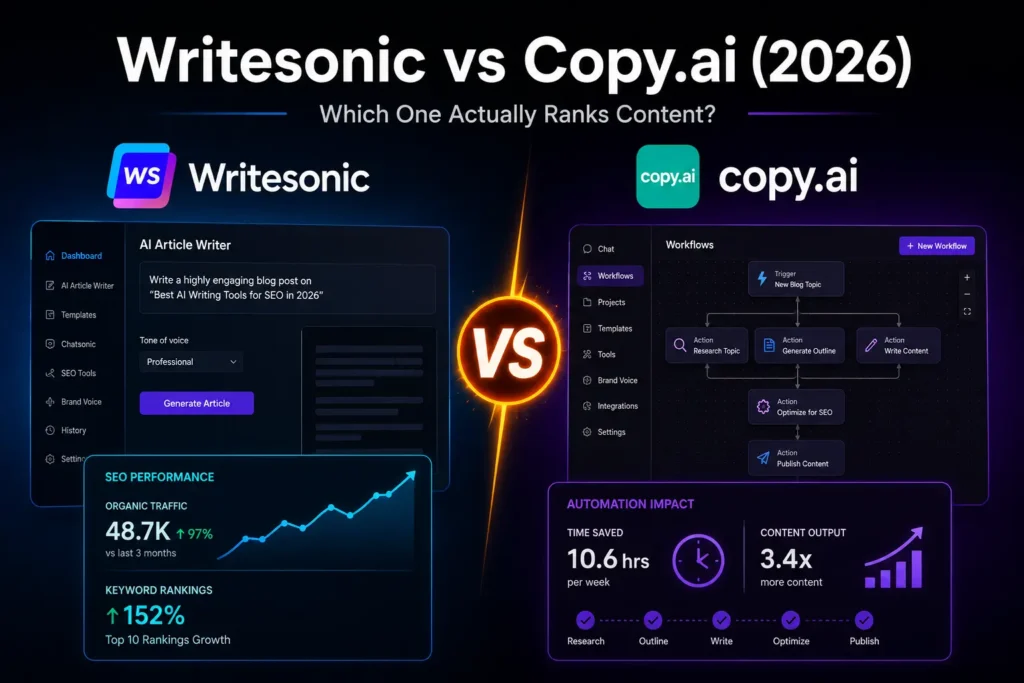
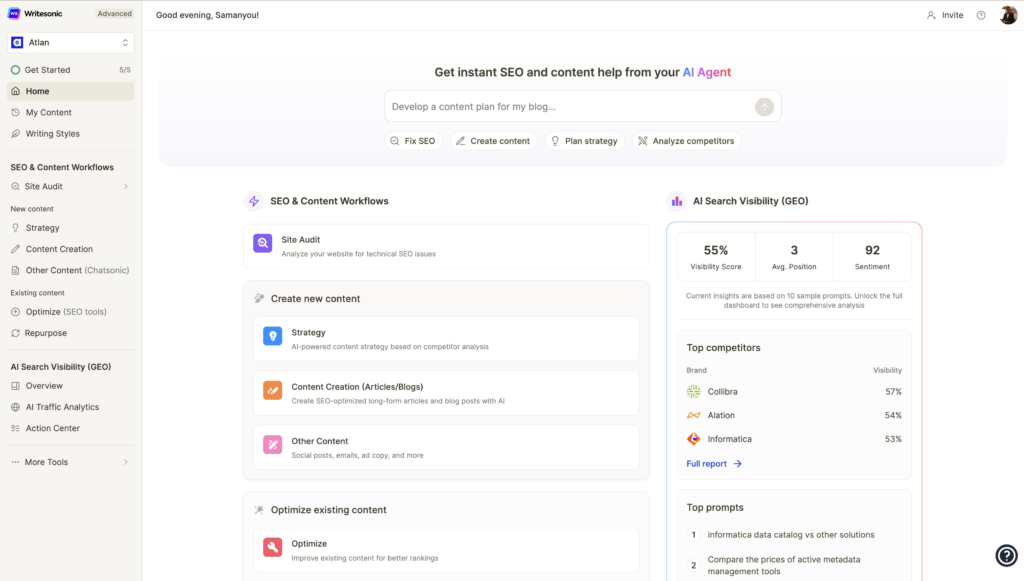
Writesonic is the tool I used most during that $500 month. It is built specifically for content marketers and SEO-focused writers, and it shows. The AI Article Writer feature walks you through a 10-step process that includes keyword analysis, competitor research, and outline creation before it writes a single word. That structure forces you to be intentional, and the output is noticeably better because of it.
For a review blog like mine, this is nearly perfect. I would enter a target keyword, let Writesonic analyze the top-ranking pages, and then guide the AI to write something better. It does not always nail the tone on the first try, but the editing workload is far lighter than starting from scratch.
The newer GEO features for optimizing content for AI search engines like ChatGPT and Gemini are interesting, but they sit behind the Professional plan at $249/month. For solo bloggers, that is steep. At the $49/month Lite tier, you are getting a solid AI writing tool for SEO content, and that alone is worth the price if you publish consistently.
One thing worth noting: Writesonic integrates directly with WordPress, which saved me a lot of copy-paste time. Write, optimize, publish. That workflow alone is worth something.
Pricing: Lite from $49/month | Professional from $249/month
Jasper
Pros
- Mature, feature-rich platform
- Brand Voice and Knowledge Base are excellent
- Good for consistent multi-channel content
Cons
- Expensive for solo creators
- Output quality not dramatically better than cheaper tools
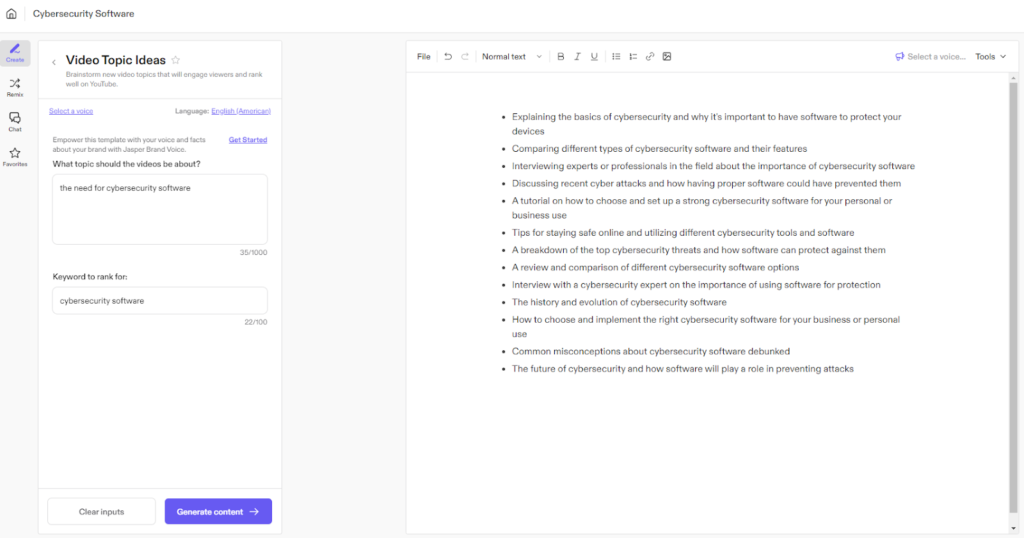
Jasper is the most feature-complete AI writing tool on this list. It has been around longer than most, and that maturity shows in how polished the product feels. Where Writesonic is built for SEO, Jasper is built for brand consistency across teams.
The Brand Voice feature is genuinely impressive. I fed it a few of my past articles and it created a voice profile: “knowledgeable, direct, slightly opinionated, with a preference for plain language over jargon.” When I used that voice profile for test posts, the output needed noticeably less editing. It actually sounded like me, or at least close enough.
For a solo blogger at $69/month, Jasper is hard to justify when Writesonic does 80 percent of the job for less. But for a small business or a content team managing multiple writers and brands, Jasper earns its price. The Knowledge Base feature alone, where you can upload brand documents and use them as a source of truth for all AI output, is worth it for teams that care about accuracy.
Pricing: Pro from $69/month
Copy.ai
Pros
- Generous free plan
- Good AI chat for writing workflows
- Pre-built templates for dozens of use cases
Cons
- Pivoting toward enterprise workflows
- Less SEO focus than Writesonic
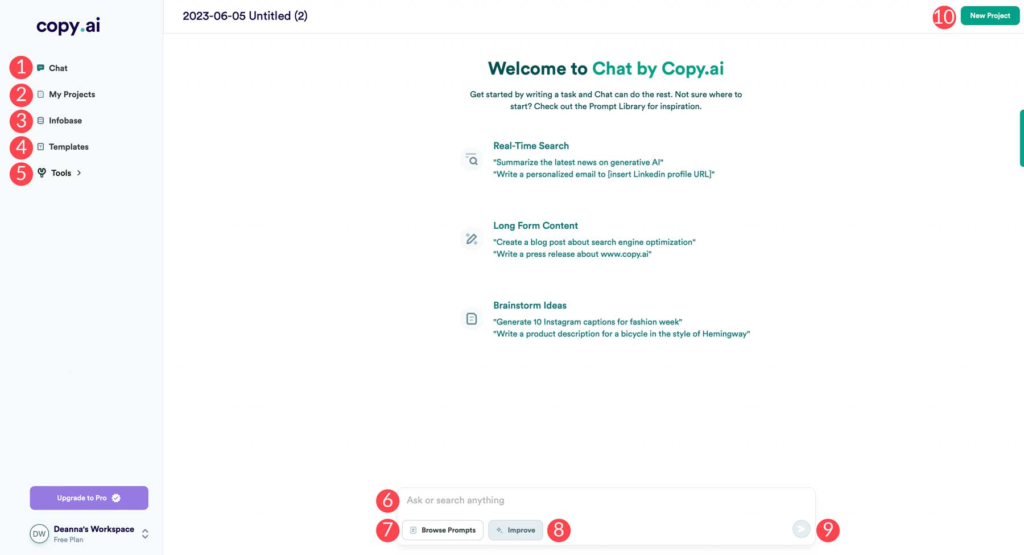
Copy.ai started as a short-form copy generator and has evolved into something closer to a full AI chat for writing. The free plan is one of the most generous I have seen: unlimited projects, access to their chat interface, and a library of templates covering everything from blog intros to email subject lines to product descriptions.
I used Copy.ai most for shorter content tasks: rewriting headlines, drafting meta descriptions, generating title variations for A/B testing. For that kind of work, it is fast and reliable. The chat interface is comfortable and the output does not need heavy editing for short-form content.
It is not my first choice for long-form SEO articles. For that, Writesonic is better. But as a free writing AI for anyone just getting started, Copy.ai is hard to beat. The free plan alone saved me hours of manual rewriting during that $500 month.
Pricing: Free plan available | Pro from $49/month
Rytr
Pros
- Cheapest unlimited plan at $9/month
- Simple and easy to use
- Good for quick drafts and short content
Cons
- Less control over output than premium tools
- Uses older models compared to competitors
- Not ideal for complex long-form content
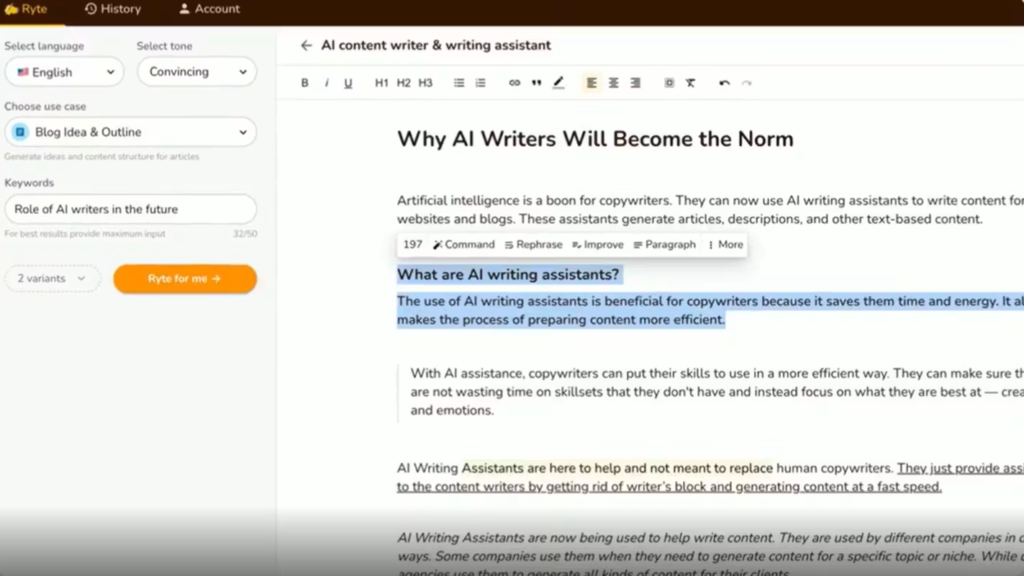
Rytr is the most affordable AI writing tool on this list and it earns its spot because of that alone. At $9/month for unlimited usage, it removes the cost barrier completely. For someone who wants to experiment with AI for writing without spending $50 to $70 a month, Rytr is the right starting point.
The output is decent for short content: social media captions, email drafts, product descriptions, and simple blog paragraphs. When I tested it for longer, more nuanced articles, it started to feel generic. There is less control over tone and brand voice compared to Writesonic or Jasper, and the tool has acknowledged using older model versions.
That said, $9/month for unlimited words is genuinely hard to argue with. If your content needs are modest or you are just starting out, Rytr will serve you well. It is a legitimate tool, not a toy.
Pricing: Free (10,000 characters/month) | Unlimited from $9/month
ChatGPT
Pros
- Extremely versatile AI chatbot for writing
- Free tier is powerful and fast
- Great for brainstorming, outlining, and editing
- Custom instructions allow basic voice control
Cons
- No built-in SEO tools
- Requires good prompts to get great output
- Free tier has limits during peak hours
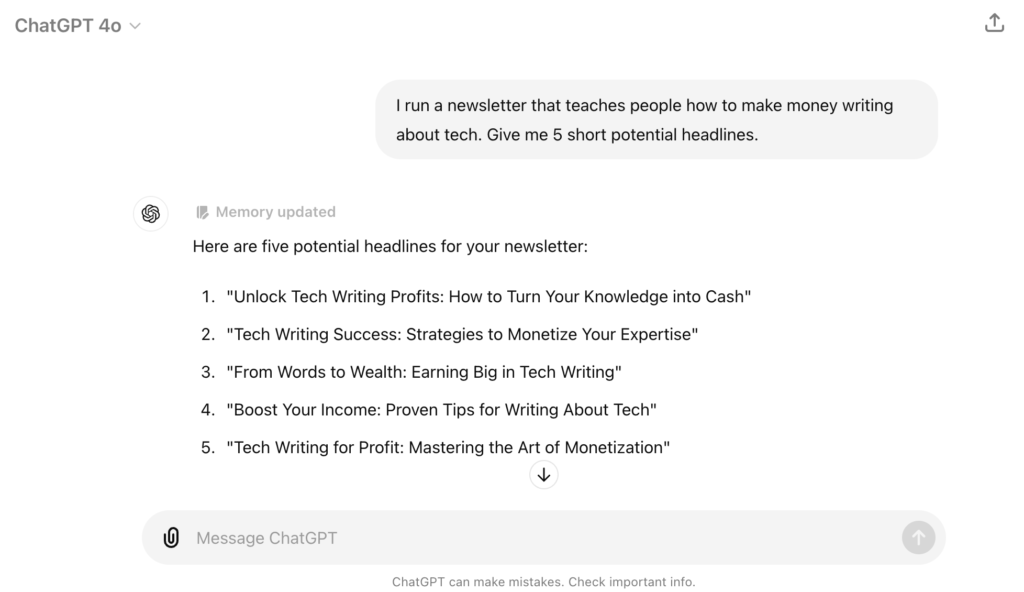
I would be lying if I said ChatGPT was not part of my workflow during that $500 month. It is the most versatile AI chatbot for writing available, and the free version is genuinely powerful for most writing tasks.
I used ChatGPT for brainstorming article ideas, generating title variations, building outlines, and rewriting sections that felt flat. It is not as SEO-focused as Writesonic and it lacks the brand consistency features of Jasper, but for raw writing speed and flexibility, nothing beats it.
The Custom Instructions feature lets you set a persistent voice and context so you do not have to re-explain your niche every time. That alone makes the writing AI experience much smoother. If you use ChatGPT Plus at $20/month, you also get access to GPT-4o which handles long-form content noticeably better than the free model.
My honest take: ChatGPT is the foundation. Tools like Writesonic are the specialization layer on top. Use both.
Pricing: Free | Plus from $20/month
My Actual Workflow: How I Combined These Tools
Here is exactly how I used these tools to publish more content and make more money in a single month:
- Keyword research first: I found low-competition keywords using standard SEO tools (not AI).
- Outline with ChatGPT: I pasted the keyword and asked for a detailed H2/H3 outline targeting search intent. Fast, free, and accurate.
- Draft with Writesonic: I used the AI Article Writer to generate a full draft based on the outline. It analyzed competitor pages and built a structured draft I could edit.
- Fill gaps with Copy.ai: For meta descriptions, intro rewrites, and short-form sections, Copy.ai was faster than going back to Writesonic.
- Final edit manually: Every article got a human pass before publishing. AI writing tools are collaborators, not replacements. The final voice has to be yours.
The honest truth about AI writing:
Every tool on this list will produce mediocre content if you let it run on autopilot. The writers making real money with these tools are the ones who treat AI as a first draft engine, not a publishing machine. Your job is to guide it, edit it, and add the perspective that no AI can replicate: yours.
Which AI Writing Tool Should You Choose?
Here is my honest recommendation based on who you are:
- You run an SEO blog or content site: Start with Writesonic. The built-in SEO features justify the price and the WordPress integration saves real time.
- You are on a tight budget: Rytr at $9/month or Copy.ai free tier. Both are legitimate and will get you started without financial risk.
- You manage a content team or brand: Jasper. The brand voice and knowledge base features are worth the higher price for teams.
- You just want a general AI chatbot for writing: ChatGPT free or Plus. It is the most flexible and the most widely supported.
- You want the best free AI for writing: Copy.ai free plan is the strongest free option for short-form content.
Final Verdict
The best AI writing tool is the one you will actually use consistently. All five tools on this list can help you write faster, rank better, and publish more. The difference is in the details: SEO features, brand control, pricing, and how well the output fits your workflow.
I made $500 in one month not because any single tool was magic, but because having the right writing AI stack let me produce 3x the content I normally would. At the end of the day, more good content beats better tools every time.
Pick one, start publishing, and optimize from there.
This article was written and tested by Milan Gami at ReviewMyTools.com. Last updated June 2026. Some links are affiliate links. All opinions are based on independent testing.