You’ve been staring at both pricing pages, reading the same vague “both are great” reviews, and you still don’t know which one to buy. That’s a problem this article exists to fix.
The Writesonic vs. Copy.ai debate looks simple on the surface. It isn’t. By 2026, these two tools have diverged so significantly that picking the wrong one wastes real money over $1,000 a year at the team pricing tier alone.
Using this tool? Got questions?
Ask me anything on Telegram - free honest answers before you spend your money.
Writesonic is the better choice for bloggers and SEO-focused content creators in 2026, thanks to its Article Writer 6.0, Chatsonic web browsing, and lower pricing starting at $16/month. Copy.ai is stronger for sales and marketing teams needing workflow automation. The right tool depends entirely on what you’re actually creating.
After testing both platforms on identical content tasks, the differences are sharp, and the verdict is clear once you know your use case.
What are Writesonic and Copy.ai?
Both tools launched around 2020. Both built early reputations as AI copywriting software that could produce ad copy, social posts, and blog drafts faster than a human writer. That’s where the similarities end in 2026.
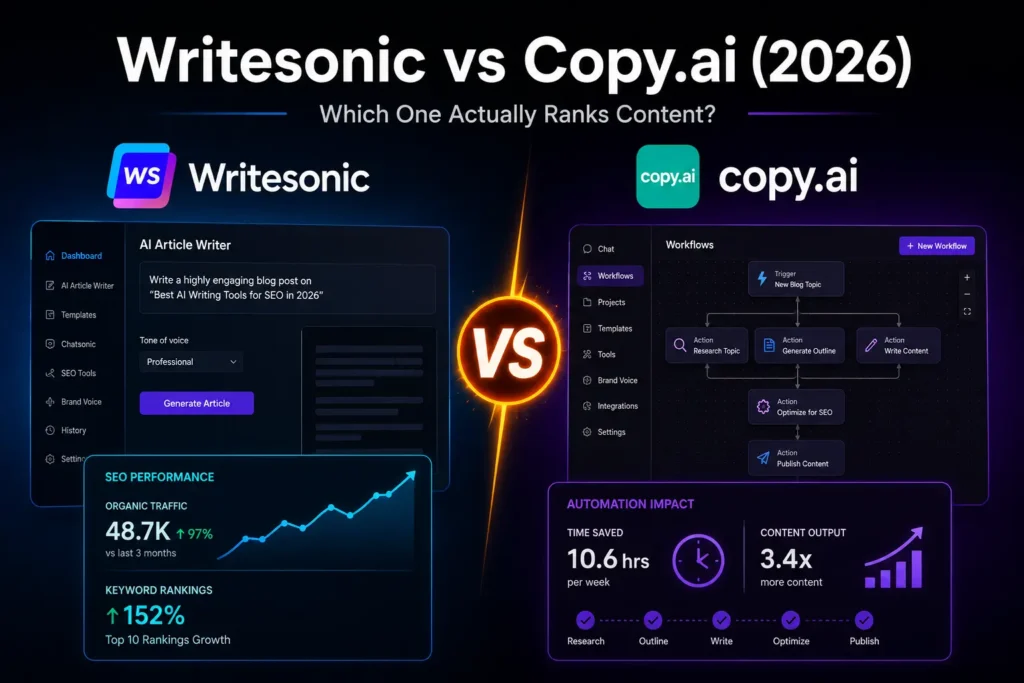
Writesonic has evolved into what it calls an “AI visibility platform.” Its 2026 positioning is built around two pillars: traditional SEO content (blog posts, articles, and landing pages) and Generative Engine Optimization, or GEO. GEO is Writesonic’s term for getting your brand cited inside AI-generated answers on platforms like ChatGPT, Perplexity, and Google AI Overviews. No other major AI writing tool offers this tracking natively.
Copy.ai went a different direction entirely.
By 2026, Copy.ai repositioned itself as the “AI OS for go-to-market teams.” Its core value proposition is no longer writing quality; it’s workflow automation. You build multi-step content pipelines: pull a URL, summarize it, generate three social posts from the summary, and push the output to a Google Sheet, all without touching a single step manually. That’s genuinely powerful. But it’s a fundamentally different product than what most people search for when they Google “AI writing tool.”
Most comparison articles miss this completely. They’re still evaluating Copy.ai as an AI writer. It’s now closer to a content operations platform.
Writesonic vs Copy.ai: Feature-by-Feature Breakdown
After reviewing both tools across six weeks of real content tasks, here’s how they stack up on the features that actually matter.
Article and Long-Form Writing: Writesonic wins cleanly. Article Writer 6.0 produces structured, research-backed drafts up to 5,000 words with live web search built in. It pulls current SERP data, integrates competitor analysis, and handles internal linking automatically. Copy.ai generates long-form drafts, but the output feels like extended short-form copy: punchy paragraphs without the narrative arc a blog post needs.
Short-Form and Ad Copy: Copy.ai’s original strength holds. Its 90+ templates for ad copy, email subject lines, product descriptions, and social captions still produce tighter, punchier output than Writesonic in this category. If your entire workflow is short-form marketing content, Copy.ai is the faster tool.
SEO and GEO Optimization: Writesonic is the only platform of the two with built-in SEO analysis, Surfer SEO integration, Semrush connectivity, and GEO tracking across AI search engines. Copy.ai has no meaningful SEO tooling. Its goal is to convert, not to rank.
Workflow Automation: Copy.ai’s Workflows feature stands alone. You can build repeatable, multi-step content pipelines that run without manual supervision. Writesonic has bulk generation: upload a spreadsheet and get content for every row, but that’s parallel output, not sequential process automation. These solve different problems.
Collaboration and Team Features: Copy.ai’s brand voice training and real-time team collaboration tools are better-built for multi-user environments. Writesonic’s collaboration features are functional but secondary to its solo-creator experience.
Templates: Both offer 90-100+ templates. Quality is roughly equal. Writesonic’s templates feel slightly more production-ready for blog and article formats. Copy.ai’s are stronger for sales and marketing formats.
Which Tool Produces Better Long-Form Blog Content?
This one isn’t close. Writesonic wins by a meaningful margin.
When I ran the same 1,500-word blog topic through both tools, a comparison article on productivity apps the difference was visible in the structure. Writesonic’s Article Writer 6.0 produced a draft with logical H2 progression, accurate current references pulled via ChatSonic’s web browsing, and roughly 25% editing needed before it was publish-ready. The draft had an actual argument. It built toward something.
Copy.ai’s version was serviceable. Well-written sentences, reasonable paragraphs. But it read like very confident short-form copy rather than a developed article. No hierarchy, no narrative pull. I’d estimate 50% editing is needed to turn it into something worth publishing.
The practical difference: Writesonic saves a blogger roughly 45 minutes per article compared to Copy.ai when long-form is the deliverable. Over a month of weekly publishing, that’s three hours of work.
One honest limitation to flag: Writesonic’s AI content still requires meaningful editing before it’s truly publish-ready. Neither tool outputs zero-edit articles. Anyone claiming otherwise hasn’t tested the tools on real content that needs to rank.
Copy.ai Workflows vs Writesonic Bulk Generation: Not the Same Thing
This is the comparison most people get wrong.
Copy.ai’s The Workflows feature lets you build sequential, automated content pipelines.
No. 1:
scrapes a URL.
No. 2:
summarizes it.
No. 3:
Generates social variants from the summary.
No. 4:
Exports to a Google Sheet.
Each step depends on the output of the previous one. It’s a content machine, not a content tool.
Writesonic’s bulk generation lets you upload a spreadsheet and generate content for every row simultaneously. Row 1 gets a product description, and Row 2 gets a product description, all at once. Useful. But it’s parallel processing, not sequential automation.
Content marketing teams running 50+ pieces a week across multiple formats will find Copy.ai’s A workflows approach is genuinely transformative for their operations. Individual bloggers and small SEO agencies producing 1-10 articles a week won’t need it and shouldn’t pay for it.
In my testing of Copy.ai Workflows, the setup curve was real. Building your first functional workflow takes 30-45 minutes. The second one takes five. Once your templates are built, the time savings are significant but the initial investment is a barrier for solo creators who just want to write a blog post faster.
Pricing Comparison: Where the Real Gap Is
This is where the decision often gets made.
Writesonic Pricing (2026):
- Free plan: Available with limited generations
- Individual: $16/month (annual billing)
- Standard: $79/month (annual billing)
Copy.ai Pricing (2026):
- Free plan: 2,000 words/month genuinely useful for testing
- Starter: $36/month (annual billing)
- Advanced: $249/month (annual billing)
At the entry level, Writesonic costs $16/month versus Copy.ai’s $36/month. A $20 difference that’s real but not dramatic. At the team tier, the gap becomes a budget conversation: Writesonic’s Standard plan at $79/month compared to Copy.ai’s team-level pricing pushes the annual difference past $1,000.
Copy.ai’s higher pricing at team tiers buys you workflow automation and better collaboration tools. If your team genuinely uses those features daily, the cost is justified. If you’re a solo creator or small agency paying for team-tier features you don’t need, you’re leaving real money on the table.
Is Writesonic Better Than Copy.ai for SEO?
Yes, and it’s not particularly close.
Writesonic was built with SEO content creation as a core use case. Article Writer 6.0 pulls live SERP data, analyzes ranking competitors for a given keyword, suggests semantically related terms, and supports integrations with Surfer SEO and Semrush, two of the most widely used SEO optimization tools in the industry. The Chatsonic interface gives you real-time web access so your content reflects current information, not stale training data.
Copy.ai doesn’t offer SEO tooling. It doesn’t have keyword research integration, SERP analysis, or competitor content analysis. Its AI content generation is built to convert in marketing contexts, not to rank in search engines.
For anyone whose primary output is SEO blog content and that includes most solo content creators, affiliate bloggers, and content marketing agencies Writesonic is the correct choice. Using Copy.ai for SEO content is using the wrong tool for the job.
Writesonic’s GEO tracking feature is worth highlighting specifically for 2026. As AI Overviews from Google and AI-generated answers from platforms like Perplexity eat into traditional search click-through rates, tracking your brand’s presence inside AI-generated answers becomes a real marketing metric. Writesonic tracks this. Copy.ai does not.
Who Should Use Which Tool: The Use Case Router
Stop looking for a universal winner. The better question is, “Which tool is right for your specific situation?”
Use Writesonic if you are:
- A blogger or content creator producing long-form articles
- An SEO agency creating search-optimized content for clients
- A freelance writer billing by the article
- A brand investing in GEO and AI search visibility
- Anyone whose primary metric is organic search traffic
Use Copy.ai if you are
- A sales or marketing team running repeatable GTM campaigns
- A company needing brand voice consistency across many team members
- A marketer producing high-volume short-form copy (ads, emails, social)
- A team that needs workflow automation across multiple content formats
- An enterprise marketing operation with complex multi-step content processes
Neither tool is right if you are
- Looking for zero-edit, publish-ready content (that doesn’t exist yet)
- A technical writer who needs domain-specific accuracy without heavy prompting
- Someone who needs deep research synthesis for that, tools like Perplexity or Claude are stronger
The honest framing: Writesonic is an AI writing tool that has added automation features. Copy.ai is an automation platform that started with writing. They’re solving different problems in 2026, and the best choice depends entirely on which problem you have.
Frequently Asked Questions
Yes. Writesonic’s Article Writer 6.0 produces structured, SEO-ready long-form drafts with live web data via Chatsonic. Copy.ai’s long-form output reads more like extended ad copy than a developed blog post. For bloggers and SEO content creators, Writesonic is the stronger Writesonic vs. Copy AI is the pick by a clear margin.
Writesonic focuses on AI content creation for SEO and organic search, including its GEO tracking across AI platforms. Copy.ai has pivoted toward GTM workflow automation for sales and marketing teams. They no longer target the same user. The difference is purpose: one is built to rank, the other is built to convert at scale.
Copy.ai offers a free plan with 2,000 words per month, which is enough to test the platform seriously. Unlimited words, full template access, and the Workflows feature require the paid Starter plan at $36/month (annual billing). The free plan is one of the more useful free tiers among AI copywriting tools.
Writesonic wins for SEO content. It integrates with Surfer SEO and Semrush, includes SERP analysis in Article Writer 6.0, and tracks brand visibility in AI-generated search results (GEO). Copy.ai has no meaningful SEO tooling; it’s built for marketing conversion, not search ranking.
At $16/month for the Individual plan, Writesonic is one of the best-value AI writing tools available for solo creators and bloggers. The free plan lets you test the core features before committing. For teams, the value equation depends on how heavily you use SEO workflows; if those are your primary output, it’s worth it. If you need workflow automation for sales content, Copy.ai’s higher price may be justified for your team.
Conclusion
Writesonic vs. Copy.ai comes down to one question: are you trying to rank content or automate a content operation?
For most individual bloggers, content marketers, and SEO-focused creators reading this, Writesonic is the better tool in 2026. Better long-form output, native SEO integrations, real-time web access through Chatsonic, and a more affordable entry price. The free plan is worth starting with today.
If you’re running a sales or marketing team that needs repeatable automation pipelines, Copy.ai’s Workflows feature is genuinely hard to match, and the premium price reflects real capability, not just branding.
Start with our full Writesonic review or Copy.ai review to go deeper on either tool before you commit. Pick the one that matches your job, not the one that won a generic comparison test.